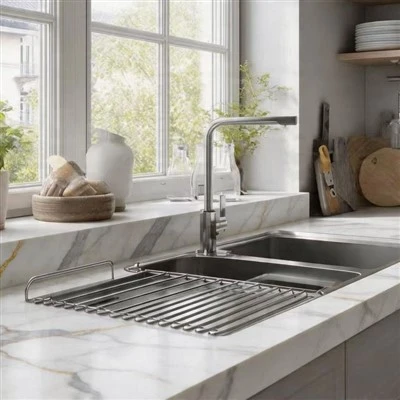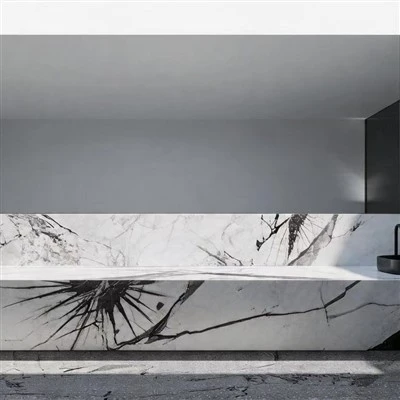
How much gap should be left between the countertop and the wall?
- Standard gap: 3-5 mm. This distance is essential to prevent the countertop from cracking due to thermal expansion and contraction. Fill the gap with anti-mold sealant after installation.
- What if the wall is uneven? If the wall error exceeds 3 mm, it is recommended to install a backsplash to cover the gap; otherwise, water seepage will easily cause mold growth in the cabinets.
- Choose the right adhesive: Use industrial adhesive or anti-mold silicone sealant to fill the gaps. Avoid using overly strong adhesives to prevent cracking later.
How much should be left for the under-edge trim?
- Under-edge trim length: 4 cm. A 4 cm under-edge trim is typically made along the outer edge of the countertop to cover the seam between the cabinet and the countertop, and to prevent water dripping onto the cabinet doors.
- Round the edges: All edges should ideally be rounded to a radius of at least 5 mm to prevent bumps and injuries. Right angles are prone to chipping and can scratch your hands.
- Choose a thickness of 1.5 cm or more: It's recommended that the countertop itself be 1.5 cm or 2 cm thick. A thinner surface is more prone to breakage when cutting vegetables.
Where to install the backsplash?
- Front backsplash: Depends on preference. A height of about 3-5 mm prevents items from rolling off, but it affects cutting space, so many people don't install it now.
- Rear backsplash: Depends on the wall: If the wall is level, you can directly apply sealant without a backsplash, reducing hard-to-clean areas; if the wall is slanted, install a backsplash to prevent water seepage.