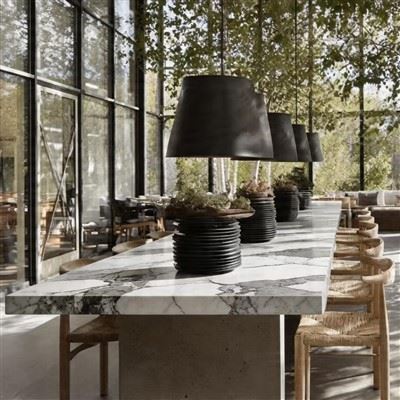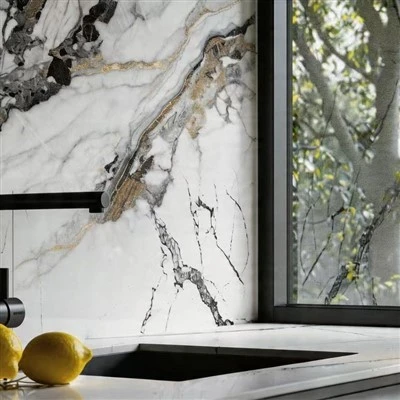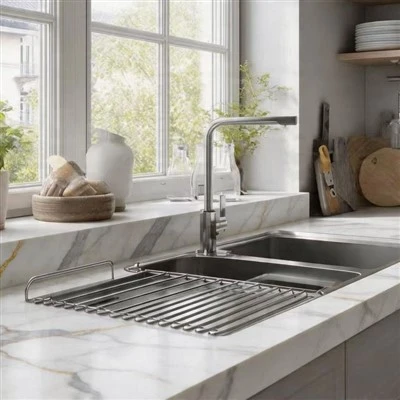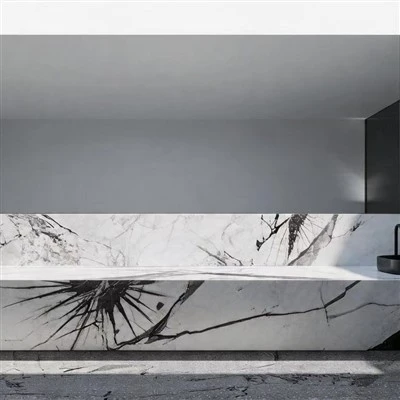
The allure of quartz stone lies in its incredibly realistic simulation. Its main component is over 93% natural quartz crystals (crushed into sand), supplemented with 5-6% unsaturated polyester resin, pigments, and stabilizers. The quartz sand provides hardness and wear resistance, while the resin acts as "glue," ensuring the slab is dense and non-porous. High-quality products have a quartz content exceeding 93%, achieving a Mohs hardness of 7, far surpassing glass (5.5) and ceramics (6-7).
The production process is akin to high-tech "alchemy." First, quartz ore is crushed and washed into high-purity sand particles; then, it is mixed evenly with resin and pigments at high speed in a vacuum environment; next, it is poured into molds and pressed into shape using a press with a pressure of tens of thousands of tons (pressure can reach 15,000 tons). Finally, it is baked at high temperature to set its shape and undergoes multiple polishing processes to ensure a mirror-like surface.
In terms of performance, artificial quartz stone stands out. It has extremely high scratch resistance, leaving almost no marks when scratched with a knife; its stain resistance is outstanding, as the lack of capillaries makes it easy to wipe clean of coffee stains or oil stains. It can withstand short-term temperatures up to 300℃, making it suitable for the high-temperature environment of a kitchen, but it should not be used to directly heat pots exceeding 150℃ to prevent resin discoloration. In terms of environmental friendliness, the silica substrate is non-radioactive, meeting the national standard GB/T 23447, far superior to some natural stones. It offers a rich selection of colors, from pure white to marble-look patterns, catering to modern minimalist or Chinese styles.
However, it's not perfect. The resin may release trace amounts of volatile organic compounds at high temperatures, and prolonged exposure to sunlight can cause fading; the price is relatively high, ranging from 400-1000 yuan per square meter for standard sizes. In practical applications, the seamless splicing of artificial quartz stone is a highlight: it can be bent into L-shaped countertops, preventing dirt from accumulating in the seams. Compared to ordinary artificial stone (resin-based, with a hardness of only 3-4, easily scratched), it's more like an "upgraded version," with a cool, natural stone feel, but without the inherent pores of natural stone. Artificial quartz stone is a perfect fusion of technology and nature, suitable for young families seeking durability and hygiene.